
Case: NA Service Cloud Integration (2025)
Kimberly Clark Professional
A Smarter Approach to Service
Kimberly Clark Professional is the non-consumer side of Kimberly Clark focused on B2B relationships and sales across North America (The United States and Canada) .
The Mission
To deliver a modern, scalable customer service experience that leverages advanced digital capabilities to empower customers and service teams.
Approach
To achieve this objective, we first sought to understand the current state across teams. This included existing ways of working, systems in use, and key touchpoints such as communication channels and external partners.
A critical focus was developing a deep understanding of each team persona and their most common use cases. To do this, we facilitated a series of process workshops that allowed us to document and evaluate current workflows, identify gaps, and surface opportunities for improvement.
Design & Alignment
With a shared understanding of the current state, the cross-functional design team began identifying key pain points and opportunities to make critical jobs to be done more efficient and measurable for team leads.
We facilitated collaborative workshops that included frontline users of the existing system, along with partners from engineering, data, and business architecture. These sessions enabled us to align on constraints, surface operational insights, and co-create potential solutions.
Building on our understanding of the current process, we overlaid a proposed future-state workflow using Salesforce Service Cloud as the primary system of record. This new approach leveraged team queues as a centralized hub for work, replacing individual Outlook inboxes that limited visibility, reporting, and collaboration.
Rollout
Completing the design and defining the new process marked only the first phase of the effort. The next step focused on driving adoption through limited pilot programs, followed by a phased rollout across all teams.
The Problem
Kimberly-Clark Professional customer service leadership identified consistent underperformance across service teams, supported by customer survey feedback, recurring SLA breaches, and low CSAT and CES scores. These metrics revealed a measurable breakdown in the overall customer experience and highlighted the need for targeted improvements to workflows, training, and performance monitoring to enable sustainable, long-term improvement.
The challenge was compounded by the operational complexity of the service organization, which consisted of four distinct service teams operating across five core processes, each with unique responsibilities and systems:
General Customer Care: Handles standard service requests originating from District Sales Representatives
Overages, Shortages, and Damages (OS&D): Manages issues related to product overages, shortages, and delivery damages
Quality: Addresses quality-related requests governed by and integrated with a third-party regulatory body
Internal Requests: Supports internal service needs across the organization
Further, the teams ways of working included fragmented systems (personal emails in Outlook, no structured business process, random spreadsheets that were not part of any teams shared process, no way of tracking and reporting for leadership)
Given the variety of scenarios, processes, and tools involved, it was critical to engage directly with each team through collaborative workshops. This approach allowed us to understand their specific jobs to be done, identify system dependencies, and uncover workflow inefficiencies that were impacting performance and customer outcomes.
Key Areas of Interest:
Current workflow had Email workflows that were not team centric and contained over 34 email addresses feeding four inboxes
Case/ request creation workflows that were inconsistent and not easily traceable across the team
Current ways of working were not sustainable; inconsistent business process with no clear line of site on KPIs (Team SLAs are key)
No Reporting was available to managers to help track poor broad performance (SLA, CSAT, CES, NPS)
Team & Collaboration
I led prioritization and phased the design effort in close partnership with North American senior leadership and Senior Directors across Sales, CX, and Marketing. Engineering was embedded throughout discovery and design to validate feasibility early and reduce downstream risk. Operating as a lean, agile team, we iterated rapidly and adapted as insights emerged.
Core Team
Product Manager / Product Designer (Design Lead)
Engineering Lead / Product Owner (Technical Lead)
Business Architect (Process Mapping)
Data Lead
Enterprise Architect
Users & Audience
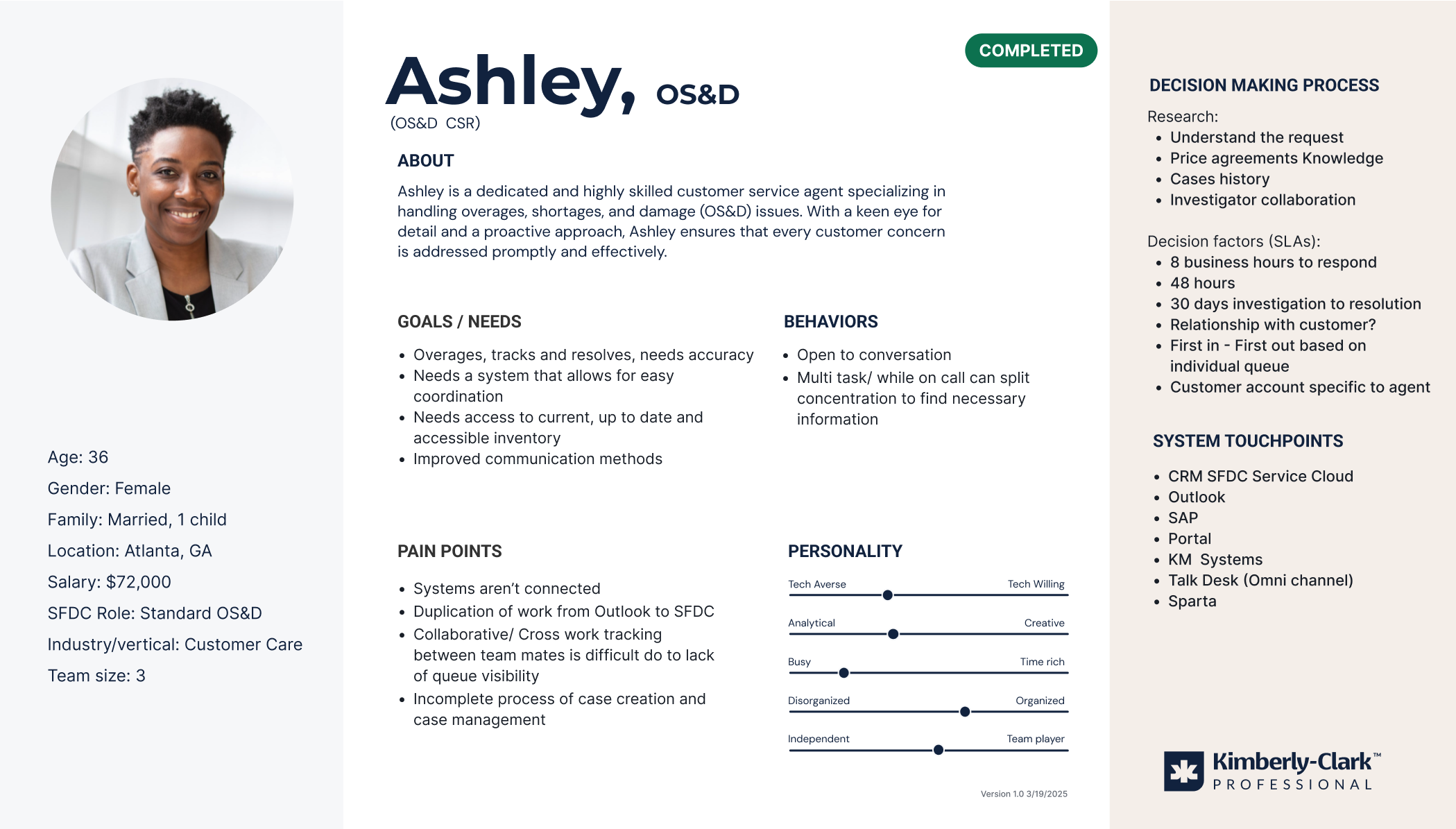
Our primary users were customer service representatives across four service teams. We developed personas for each system end user—including both leads and non-leads—grounded in a clear understanding of their jobs to be done. Once we identified the most common and critical tasks, the team collaboratively explored how best to support these workflows within the selected CRM platform (Salesforce Service Cloud).
Using our understanding of who our users were, what they did, and how they interacted with B2B customers, we created process maps that documented current-state tasks and mapped them to our value streams and organizational capabilities. This work enabled us to clearly identify user roles, workflows, and all key touchpoints across the service experience. As a result, we gained visibility into external dependencies and partner teams that needed to be considered in the end-to-end solution.
Design Process
Discovery, exploration, design, and implementation followed a structured, end-to-end approach. We began by aligning as a core team on stakeholder needs—clarifying the underlying problems to be solved and the outcomes stakeholders were seeking. This phase focused on understanding the challenge from the stakeholder perspective and establishing a shared definition of what “good” looked like before moving into solution exploration.
Next, the team defined scope and high-level requirements to ensure alignment and feasibility prior to entering detailed design. At this stage, I partnered closely with the Business Architect to understand the most common service scenarios. We facilitated a series of workshops with each of the three service teams, with follow-up sessions tailored to the complexity and needs of each group.
The workshops resulted in collaboratively developed process flows that documented how work was completed across systems, teams, and handoffs. These flows served as a foundational blueprint for design—clarifying task sequences, system interactions, and cross-functional dependencies required for successful service case resolution.
Once the core team had sufficient clarity to explore solutions, we moved into participatory design workshops that included our technical lead. As we designed flows, layouts, and interaction models—from entry points through resolution—we validated ideas in real time against existing architectural constraints. This approach ensured feasibility while still allowing space to challenge assumptions and explore boundary-pushing concepts. Having engineering embedded from the outset helped us balance innovation with practicality and reduced rework later in the process.
Once foundational inputs—personas, common tasks, pain points, existing architecture, and process flows—were established, we moved into collaborative UX design. Working directly with each service team, we began sketching low-fidelity wireframes that translated process insights into concrete layouts, sections, controls, fields, and interactions. Design decisions were driven by key decision points identified during process-mapping exercises.
Wireframing sessions were intentionally cross-functional, involving the core team as well as system end-user CSRs through participatory design workshops. As concepts were iterated, the wireframes evolved into more complete experiences and ultimately into high-fidelity, pixel-perfect prototypes in Figma.
These prototypes were tested with additional CSRs beyond the design sessions to validate assumptions and ensure consistency across teams. We used scenario-based validation and measures such as time on task and successful scenario completion to assess usability and refine the experience before moving into implementation.
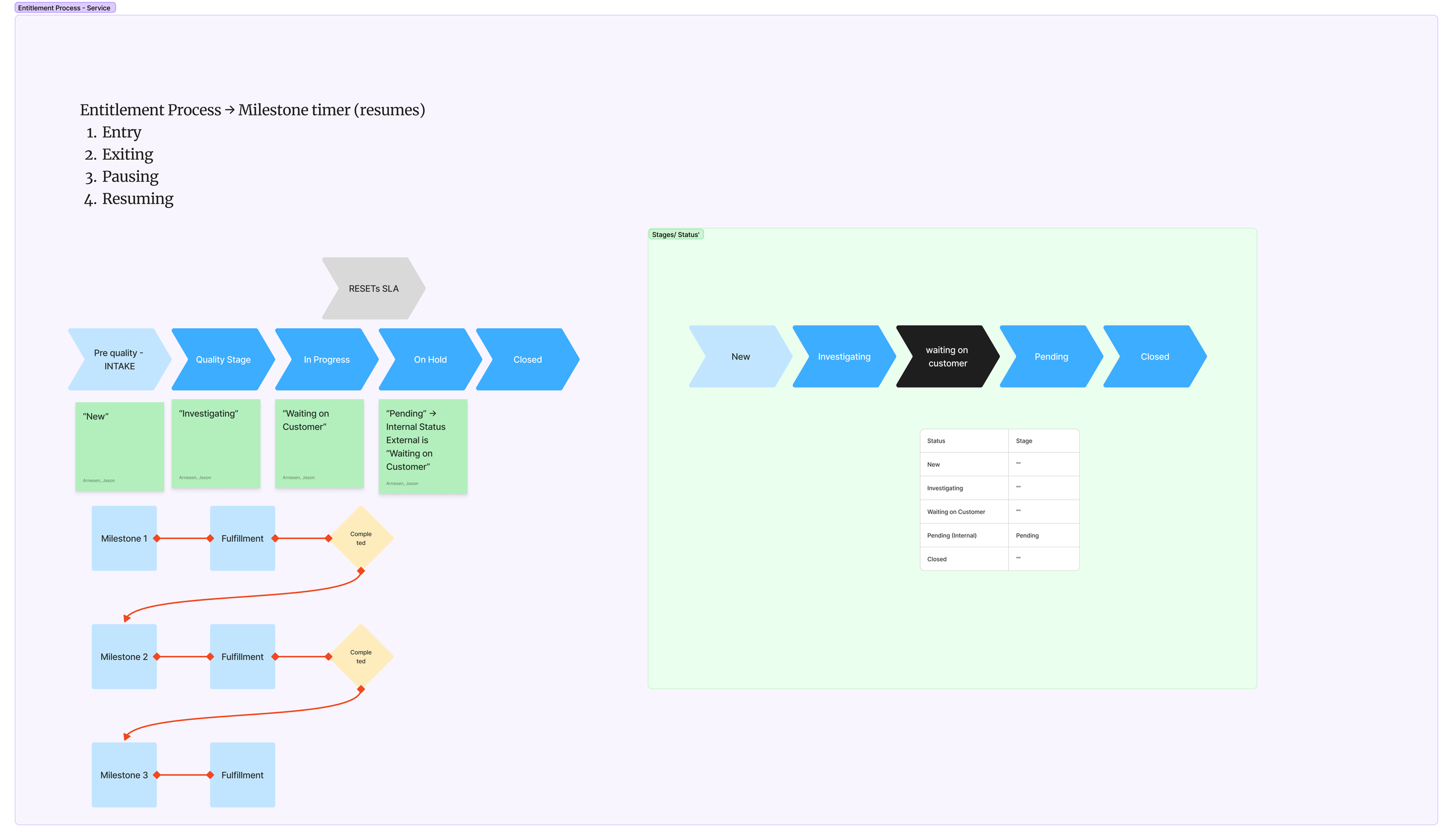
Working with the service teams to find the most common steps in their shared path. Objective was to bucket each step from entry to exit that would allow for efficient workflow. This work lead into milestones definition, which ultimately led into SLA time integration into the case life cycle
Testing and Follow up
Our goal was to validate the MVP across representative service teams ahead of a full rollout. Testing focused on ensuring the solution supported real-world service workflows, reduced friction, and could scale across teams with varying levels of experience. And since systems would be changing, we needed to make sure there was clarity on the ways of working within each team (e.g., Outlook inboxes changing to Salesforce, Service Cloud team queues).
We conducted testing with:
PIQ (Quality)
OS&D (Overages, Shortages & Damages)
General Customer Care (pilot cohort)
Given the size and diversity of General Customer Care, we intentionally worked with a pilot group to mitigate risk and gather focused feedback before broader deployment.
Testing methods included:
Scenario-based task walkthroughs
Time-on-task observation
Successful case completion rates
Qualitative feedback from CSRs and team leads
Cross-functional reviews with Engineering and Product/ Business
Based on testing feedback, we made targeted refinements to the MVP, including:
Simplifying key workflows and decision points
Improving labeling, defaults, and inline guidance
Adjusting layouts to prioritize the most frequently used actions
Refining system handoffs to better reflect real-world service sequences
Changes were validated with follow-up reviews and incorporated into the rollout plan.
Post-MVP, several opportunities were identified for future enhancement:
Expanded support for advanced or edge-case scenarios
Role-based optimizations for experienced vs. newer CSRs
Additional automation to reduce manual steps
Deeper reporting and visibility for team leads and managers
Broader rollout to the full General Customer Care organization
These iterations were intentionally scoped beyond the MVP to allow the initial release to deliver value quickly while providing a clear roadmap for continued improvement.
The Outcome
Our objective was to deliver and integrate an MVP by the start of Q4 2025 across all service teams. This included the Quality team (PIQ), the Overages, Shortages & Damages team (OS&D), and the broader General Customer Care organization.
Given the size and relative experience level of General Customer Care, we partnered with a smaller pilot group to validate the solution before wider rollout.
As of Q4 2025 our service teams are all using the newly designed integration along with ways of working. To help facilitate the design team has undergone a fairly comprehensive change management program that includes providing ‘Teams’ chats — open dialogue at any point in the
workday, and weekly individual team workshops where the design and engineering team are able to field questions, concerns, and address technical issues. These are tracked with an individual team log that is updated daily.
Currently, the design team along with business stakeholders are tracking performance through our newly defined SLAs. The SLAs are part of the new leadership dashboard experience and are one KPI that is being leveraged to help identify and remediate service issues in our customer experience.